
Whyser
Whyser

An AI-powered qualitative research platform that helps teams conduct interviews and generate insights faster.
An AI-powered qualitative research platform that helps teams conduct interviews and generate insights faster.


PROJECT TYPE
Course Project for a Master’s level Capstone course
PROJECT TYPE
Course Project for a Master’s level Capstone course
CLIENT
Whyser
CLIENT
Whyser
DURATION
4 Months
DURATION
4 Months
ROLE
UX Consultant
UI Designer
ROLE
UX Consultant
UI Designer
TOOLS
Figma, Whyser, Figjam,
TOOLS
Figma, Whyser, Figjam,
PROJECT OVERVIEW
As part of a UX capstone project, my team partnered with Whyser, an AI-powered qualitative research platform, to explore how trust is formed during a user's first experience with the product.
Through stakeholder workshops, heuristic evaluations, secondary research, and interviews with experienced researchers, we investigated what builds trust in Whyser, what aspects of the experience degrade trust, and how the first-study setup process can better support user success.
PROJECT OVERVIEW
As part of a UX capstone project, my team partnered with Whyser, an AI-powered qualitative research platform, to explore how trust is formed during a user's first experience with the product.
Through stakeholder workshops, heuristic evaluations, secondary research, and interviews with experienced researchers, we investigated what builds trust in Whyser, what aspects of the experience degrade trust, and how the first-study setup process can better support user success.
WHAT IS WHYSER?
WHAT IS WHYSER?
Whyser is an AI-powered qualitative research platform
Whyser is an AI-powered qualitative research platform
that helps teams conduct AI-moderated interviews and generate insights more efficiently. Based in San Francisco and founded in 2024. The company operates mainly in the enterprise domain and provides mainly B2B services with their product, focusing on AI-driven research tools that enable user researchers to set up their studies, recruit participants, carry out studies and gather user insights through the AI-moderated interview and analysis platform. The primary users of the product include product managers, UX researchers, marketers, and customer insight teams.
that helps teams conduct AI-moderated interviews and generate insights more efficiently. Based in San Francisco and founded in 2024. The company operates mainly in the enterprise domain and provides mainly B2B services with their product, focusing on AI-driven research tools that enable user researchers to set up their studies, recruit participants, carry out studies and gather user insights through the AI-moderated interview and analysis platform. The primary users of the product include product managers, UX researchers, marketers, and customer insight teams.
THE CHALLENGE
THE CHALLENGE
How might we improve first-time experience in Whyser by making value clearer on the landing page and onboarding more guided and confidence-building?
How might we improve first-time experience in Whyser by making value clearer on the landing page and onboarding more guided and confidence-building?
PROCESS OVERVIEW
Discovery & Framing
Identified early friction in Whyser’s first-time experience and refined the problem scope.
PHASE 01
01
Heuristic evaluation of problem
Stakeholder alignment
Narrowed focus to first-time value discovery
PHASE 03
03
Secondary Research
Explored trust in AI systems and identified key trust signals that shape user confidence.
Literature review on AI trust
Competitive analysis
Synthesized trust principles
PHASE 04
04
Primary Research
Conducted in-depth interviews with experienced researchers using both human and AI moderation.
12 participant interviews:
8 Human-moderated interviews
3 AI-moderated interviews via Whyser
PHASE 02
02
Research Planning
Defined research questions, hypotheses, and structured mixed-method study approach.
Research questions & hypotheses
Study design (AI + Human interviews)
Screener, interview guide, and study preparation
PHASE 01
01
Discovery & Framing
Identified early friction in Whyser’s first-time experience and refined the problem scope.
Heuristic evaluation of problem
Stakeholder alignment
Narrowed focus to first-time value discovery
PHASE 02
02
Research Planning
Defined research questions, hypotheses, and structured mixed-method study approach.
Research questions & hypotheses
Study design (AI + Human interviews)
Screener, interview guide, and study preparation
PHASE 05
05
Discovery Playback
Synthesized insights and aligned with stakeholders on key opportunity areas.
Thematic analysis & user persona
Insight synthesis
Presented findings & opportunities
PHASE 06
06
Design, Tests, and Iterations
Translated insights into design solutions, performed usability testing, and iterated on findings.
Two deliverables:
Landing page redesign
Guided onboarding experience
Usability testing & refinements
Execution Playback
Finalized design solutions and delivered final validated recommendations.
PHASE 07
07
Finalized design prototype
Execution playback presentation
Handoff ready to ship
PHASE 03
03
Secondary Research
Explored trust in AI systems and identified key trust signals that shape user confidence.
Literature review on AI trust
Competitive analysis
Synthesized trust principles
PHASE 04
04
Primary Research
Conducted in-depth interviews with experienced researchers using both human and AI moderation.
12 participant interviews:
8 Human-moderated interviews
3 AI-moderated interviews via Whyser
PHASE 05
05
Discovery Playback
Synthesized insights and aligned with stakeholders on key opportunity areas.
Thematic analysis & user persona
Insight synthesis
Presented findings & opportunities
PHASE 06
06
Design, Tests, and Iterations
Translated insights into design solutions, performed usability testing, and iterated on findings.
Two deliverables:
Landing page redesign
Guided onboarding experience
Usability testing & refinements
PHASE 07
07
Execution Playback
Finalized design solutions and delivered final validated recommendations.
Finalized design prototype
Execution playback presentation
Handoff ready to ship
DISCOVERY & FRAMING
DISCOVERY & FRAMING
Understanding the Problem
Understanding the Problem
Heuristic Evaluation
Heuristic Evaluation
To establish a baseline understanding of the product, each team member independently conducted a heuristic evaluation of Whyser from the perspective of a first-time user.
To establish a baseline understanding of the product, each team member independently conducted a heuristic evaluation of Whyser from the perspective of a first-time user.
We identified recurring usability concerns related to:
We identified recurring usability concerns related to:
Onboarding and progressive disclosure
Onboarding and progressive disclosure
Navigation and next-step clarity
Navigation and next-step clarity
Intuitive labelling
Intuitive labelling
Form validation and error recovery
Form validation and error recovery
Workflow continuity
Workflow continuity

Opportunities for Improvement (Landing Page)
Opportunities for Improvement (Landing Page)
1
1
‘Try AI Interview’ as CTA
‘Try AI Interview’ as CTA
Users assumed the AI interview was the main feature
AI interview analysis and participant recruitment were not clearly communicated upfront
Users assumed the AI interview was the main feature
AI interview analysis and participant recruitment were not clearly communicated upfront
Severity: HIGH
Frequency: HIGH
Severity: HIGH
Frequency: HIGH

2
2
Missing Information on Free Trial Sign-Up Page
Missing Information on Free Trial Sign-Up Page
Core product features and vision are not revealed upfront
Included free trial features are not clearly communicated
Core product features and vision are not revealed upfront
Included free trial features are not clearly communicated
Severity: HIGH
Frequency: HIGH

vs.

3
3
High-Level Description Is Too Vague
High-Level Description Is Too Vague
Needs clearer emphasis on detailed features
Would benefit from more visual examples of the feature UI
Needs clearer emphasis on detailed features
Would benefit from more visual examples of the feature UI
Severity: HIGH
Frequency: HIGH
Severity: HIGH
Frequency: HIGH


Opportunities for Improvement (Study Set-up)
Opportunities for Improvement (Study Set-up)
1
1
Onboarding & Progressive Disclosure
Onboarding & Progressive Disclosure
Reduce initial overwhelm
Contextual guidance
Prioritize key steps
Reduce initial overwhelm
Contextual guidance
Prioritize key steps
Severity: HIGH
Frequency: HIGH
Severity: HIGH
Frequency: HIGH

2
2
Navigation &
Next-Step Clarity
Navigation & Next-Step Clarity
Next step CTAs
Breadcrumb trail
Pause/return options
Next step CTAs
Breadcrumb trail
Pause/return options
Severity: HIGH
Frequency: HIGH
Severity: HIGH
Frequency: HIGH

3
3
Intuitive Labeling
Intuitive Labeling
Use intuitive labeling
Streamline recruitment flow
Use intuitive labeling
Streamline recruitment flow
Severity: MEDIUM
Frequency: LOW
Severity: MEDIUM
Frequency: LOW

4
4
Form Validation & Feedback
Form Validation & Feedback
Missing required fields are not visually highlighted
Error messages do not guide users to the relevant section
Clicking section names does not navigate to the error location
Missing required fields are not visually highlighted
Error messages do not guide users to the relevant section
Clicking section names does not navigate to the error location
Severity: MEDIUM
Frequency: MEDIUM
Severity: MEDIUM
Frequency: MEDIUM

5
5
Action Options Disappear on Return
Action Options Disappear on Return
Navigating away and returning causes the Create Study / Make Changes options to disappear.
Navigating away and returning causes the Create Study / Make Changes options to disappear.
Severity: HIGH
Frequency: MEDIUM
Severity: HIGH
Frequency: MEDIUM
Evaluation Insights
Evaluation Insights
These findings helped us align with stakeholders and narrow the project focus from broad AI trust to first-time value discovery.
These findings helped us align with stakeholders and narrow the project focus from broad AI trust to first-time value discovery.
RESEARCH PLANNING
RESEARCH PLANNING
Research Approach
Research Approach
Research goals
Research goals
Understand how trust is formed, reinforced, or broken during a user's first experience with Whyser.
Identify barriers that prevent users from discovering value early in their journey.
Explore how researchers evaluate the credibility of AI-powered research tools.
Participants
Participants
8 individuals
Experienced professionals
5 participants
userinterview.com
Method
Method
Secondary research
User interviews
Human-moderated
AI-moderated
SECONDARY RESEARCH
SECONDARY RESEARCH
The study began with secondary research where we performed literature review and competitive analysis to understand the core question on trust in AI moderated research tools.
The study began with secondary research where we performed literature review and competitive analysis to understand the core question on trust in AI moderated research tools.
The Literature Review
The Literature Review
Revealed how user trust is formed
How to measure user trust and a system’s trustworthiness
Revealed how user trust is formed
How to measure user trust and a system’s trustworthiness
This provided a theoretical framing for our research and design approach.
This provided a theoretical framing for our research and design approach.
Competitive Analysis
Competitive Analysis
Highlights the effective patterns such as:
Guided workflows
Templates
Demo environments that reduce cognitive load
Allow users to notice values within the corresponding platform in the early exploration phase
Highlights the effective patterns such as:
Guided workflows
Templates
Demo environments that reduce cognitive load
Allow users to notice values within the corresponding platform in the early exploration phase
PRIMARY RESEARCH
PRIMARY RESEARCH
To gain a holistic understanding of trust, we conducted both human-moderated and AI-moderated interviews.
To gain a holistic understanding of trust, we conducted both human-moderated and AI-moderated interviews.
This approach allowed us to compare user perceptions with their real interactions within Whyser, creating a stronger connection between our research findings and the platform itself.
This approach allowed us to compare user perceptions with their real interactions within Whyser, creating a stronger connection between our research findings and the platform itself.
01 - Human-Moderated Interviews
01 - Human-Moderated Interviews
Objective
Objective
To understand how experienced researchers evaluate trust in AI-powered research tools and identify what influences their willingness to adopt and continue using Whyser.
To understand how experienced researchers evaluate trust in AI-powered research tools and identify what influences their willingness to adopt and continue using Whyser.
We conducted 8 human-moderated interviews:
We conducted 8 human-moderated interviews:
5 participants via userinterview.com
5 participants via userinterview.com
1 participant via course instructor
1 participant via course instructor
2 participants via Whyser’s stakeholder
2 participants via Whyser’s stakeholder
Participants included:
Participants included:
UX researchers, designers, and product professionals who regularly conduct user research
UX researchers, designers, and product professionals who regularly conduct user research
Professionals with at least one year of experience
Professionals with at least one year of experience
These participants were selected because they have established research workflows and a higher threshold for trusting AI-generated insights.
These participants were selected because they have established research workflows and a higher threshold for trusting AI-generated insights.
What We Explored
What We Explored
During the interviews, we investigated:
During the interviews, we investigated:
First impressions of Whyser's landing page
First impressions of Whyser's landing page
Expectations for onboarding and first-study setup
Expectations for onboarding and first-study setup
Factors that influence trust in AI research tools
Factors that influence trust in AI research tools
Perceptions of AI-generated insights and analysis quality
Perceptions of AI-generated insights and analysis quality
Previous experiences with AI-moderated platforms
Previous experiences with AI-moderated platforms
Characteristics of an ideal research tool
Characteristics of an ideal research tool
Key Findings
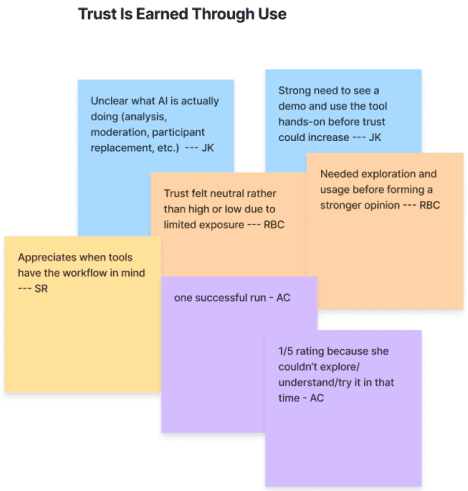
Trust is Earned Through Proof
Trust is Earned Through Proof
Participants understood that Whyser was an AI-powered research tool, but many felt the landing page relied heavily on marketing language and lacked concrete evidence of value.
Participants understood that Whyser was an AI-powered research tool, but many felt the landing page relied heavily on marketing language and lacked concrete evidence of value.
Users wanted:
Product demonstrations
Real examples of outputs
Clear explanations of how the AI works
Evidence that the platform delivers reliable insights
Users wanted:
Product demonstrations
Real examples of outputs
Clear explanations of how the AI works
Evidence that the platform delivers reliable insights
Researchers Need Transparency and Control
Researchers Need Transparency and Control
Trust increased when participants felt they could understand, verify, and influence the research process.
Trust increased when participants felt they could understand, verify, and influence the research process.
Key trust builders included:
Reviewing interview questions before launch
Understanding how AI-generated probes are created
Interactive citations linking insights to source data
Clear visibility into AI decision-making
Key trust builders included:
Reviewing interview questions before launch
Understanding how AI-generated probes are created
Interactive citations linking insights to source data
Clear visibility into AI decision-making
Reliability is a Non-Negotiable Trust Factor
Reliability is a Non-Negotiable Trust Factor
Technical issues were among the strongest trust breakers identified.
Technical issues were among the strongest trust breakers identified.
Participants cited:
Bugs and platform instability
Lost recordings or data
Inconsistent system behavior
Hallucinated or weakly-supported insights
Participants cited:
Bugs and platform instability
Lost recordings or data
Inconsistent system behavior
Hallucinated or weakly-supported insights
Guidance Matters During First-Time Setup
Guidance Matters During First-Time Setup
While participants appreciated Whyser's structured workflow, many felt the experience lacked guidance.
While participants appreciated Whyser's structured workflow, many felt the experience lacked guidance.
Common concerns included:
Unclear interview constraints
Uncertainty about AI autonomy
Setup taking longer than expected
Difficulty understanding what would happen next
Common concerns included:
Unclear interview constraints
Uncertainty about AI autonomy
Setup taking longer than expected
Difficulty understanding what would happen next
02 - AI-Moderated Interviews
02 - AI-Moderated Interviews
Objective
Objective
To evaluate how researchers engage with AI-moderated research experiences and compare their perceptions with findings from our human-moderated interviews.
To evaluate how researchers engage with AI-moderated research experiences and compare their perceptions with findings from our human-moderated interviews.
Because Whyser's core value proposition is AI-moderated research, we wanted participants to experience this interaction first-hand.
Because Whyser's core value proposition is AI-moderated research, we wanted participants to experience this interaction first-hand.
Using Whyser's interview capabilities allowed us to observe trust-building and trust-breaking moments in the actual product experience rather than relying solely on discussion and recall.
Using Whyser's interview capabilities allowed us to observe trust-building and trust-breaking moments in the actual product experience rather than relying solely on discussion and recall.
We conducted 3 AI-moderated interviews via Whyser with experienced professionals:
We conducted 3 AI-moderated interviews via Whyser with experienced professionals:

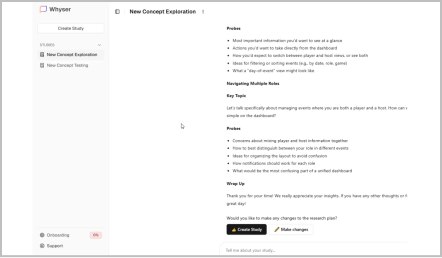
What Whyser looks like from the researcher’s POV
^ What Whyser looks like from the researcher’s POV
Why We Chose This Method
Why We Chose This Method
Trust in AI is often difficult to assess through conversation alone. Many concerns only emerge when users actively interact with an AI system.
Trust in AI is often difficult to assess through conversation alone. Many concerns only emerge when users actively interact with an AI system.
By conducting AI-moderated interviews through Whyser, we were able to:
By conducting AI-moderated interviews through Whyser, we were able to:
Observe participant reactions in real time
Observe participant reactions in real time
Identify friction points within the interview experience itself
Identify friction points within the interview experience itself
Understand how users evaluate AI-generated questions and probes
Understand how users evaluate AI-generated questions and probes
Validate themes emerging from our human-moderated interviews
Validate themes emerging from our human-moderated interviews
Explore perceptions of AI autonomy and control
Explore perceptions of AI autonomy and control
This approach also allowed us to assess whether Whyser's AI experience aligned with participant expectations of a trustworthy research tool.
This approach also allowed us to assess whether Whyser's AI experience aligned with participant expectations of a trustworthy research tool.
Key Findings via Whyser
Key Findings via Whyser


DISCOVERY PLAYBACK
DISCOVERY PLAYBACK
Research Outcomes
Research Outcomes
What builds trust in Whyser as a solution? (pre-purchase)
What builds trust in Whyser as a solution? (pre-purchase)
To better understand the general public, scoured news articles, academic sources, reviews, and competitor analysis to better inform user research.
To better understand the general public, scoured news articles, academic sources, reviews, and competitor analysis to better inform user research.
Landing page clarity matters
Landing page clarity matters
Recognized “AI research tool,” but messaging felt vague/marketing
Recognized “AI research tool,” but messaging felt vague/marketing
“It looks like a sales pitch rather than an invitation to explore”
“It looks like a sales pitch rather than an invitation to explore”
Key pre-purchase requirement
Key pre-purchase requirement
See a demo + use it hands-on
See a demo + use it hands-on
Visual polishing helps but its not sufficient for building trust right away
Visual polishing helps but its not sufficient for building trust right away
Trust factors
Trust factors
Tool works consistently
Tool works consistently
Researcher has more control over key decisions
Researcher has more control over key decisions
Pricing feels transparent/fair
Pricing feels transparent/fair
What Elements of user experience currently degrades trust?
What Elements of user experience currently degrades trust?
Lack of onboarding and progressive guidance
Lack of onboarding and progressive guidance
Setup feels structured, but not guided, which creates uncertainty.
Setup feels structured, but not guided, which creates uncertainty.
Unclear constraints and AI autonomy
Unclear constraints and AI autonomy
Users aren’t always sure how the AI will behave or how much control they have.
Users aren’t always sure how the AI will behave or how much control they have.
Reliability issues
Reliability issues
Bugs, instability, or potential data loss are immediate trust breakers.
Bugs, instability, or potential data loss are immediate trust breakers.
Complexity creep
Complexity creep
As features accumulate, cognitive load increases.
As features accumulate, cognitive load increases.
AI answer quality
AI answer quality
Hallucinations or overconfident outputs with weak evidence quickly reduce trust.
Hallucinations or overconfident outputs with weak evidence quickly reduce trust.

How can the setup for the first study build trust & lead to success?
How can the setup for the first study build trust & lead to success?
What users told us they want:
What users told us they want:
Control and reviewability
See and edit questions, understand probes, and know what the AI is doing.
Control and reviewability
See and edit questions, understand probes, and know what the AI is doing.
Human-level output quality
Human-level output quality
Reliability is non-negotiable
Stability and no data loss are foundational.
Reliability is non-negotiable
Stability and no data loss are foundational.
Interactive citations
Linking insights to source recordings builds trust.
Interactive citations
Linking insights to source recordings builds trust.
Biggest blockers to first-study success:
Biggest blockers to first-study success:
Setup friction
Setup friction
Unclear constraints
Unclear constraints
Unclear AI autonomy
Unclear AI autonomy
User Persona
User Persona
Given the scope and focus of the project, we decided to focus on UX researchers as our stakeholder and created the persona after gathering data from the study.
Given the scope and focus of the project, we decided to focus on UX researchers as our stakeholder and created the persona after gathering data from the study.

What Does This Mean For Whyser?
What Does This Mean For Whyser?
Trust is built through interaction
Trust is built through interaction
Trust in Whyser isn’t automatic. It is built through interaction.
Trust in Whyser isn’t automatic. It is built through interaction.
Lack of first-time value discovery
Lack of first-time value discovery
Biggest barrier to first-time value discovery: users don’t see concrete proof of value early enough
Biggest barrier to first-time value discovery: users don’t see concrete proof of value early enough
Abstract landing page messaging
Abstract landing page messaging
Messages feel abstract
Messages feel abstract
Unguided setup
Unguided setup
Setup feels structured but not guided
Setup feels structured but not guided
Unclear AI behaviour
Unclear AI behaviour
Constraints or AI behaviour aren’t always fully transparent
Constraints or AI behaviour aren’t always fully transparent
NEXT STEPS
NEXT STEPS
First study setup: build trust & lead to success
First study setup: build trust & lead to success
In the design phase, we will focus on embedding these trust cues directly into the first-time experience to strengthen value discovery from the very start.
In the design phase, we will focus on embedding these trust cues directly into the first-time experience to strengthen value discovery from the very start.

Surface value earlier through demos, examples, and visible insight outputs
Surface value earlier through demos, examples, and visible insight outputs
Turn the first study setup into a guided experience with clearer expectations and progressive support
Turn the first study setup into a guided experience with clearer expectations and progressive support
Reinforce researcher control and reliability, because predictability and stability are foundational to trust
Reinforce researcher control and reliability, because predictability and stability are foundational to trust
DESIGN, TESTS & ITERATIONS
DESIGN, TESTS & ITERATIONS
The team worked on 2 deliverables
The team worked on 2 deliverables
Our researched showed that trust needed to be established before users ever experienced Whyser’s core functionality. Participants wanted to see concrete proof of value, while first-time users needed more guidance and reassurance when learning the platform.
Our researched showed that trust needed to be established before users ever experienced Whyser’s core functionality. Participants wanted to see concrete proof of value, while first-time users needed more guidance and reassurance when learning the platform.
We translated these findings into two design opportunities:
We translated these findings into two design opportunities:
Surface value earlier
Surface value earlier
Redesigned the landing page
Make Whyser’s value tangible through demos, examples, and visible outputs
Redesigned the landing page
Make Whyser’s value tangible through demos, examples, and visible outputs
Guide users through their first experience
Guide users through their first experience
Turn onboarding experience into a clearer, more guided experience to be easier to complete and reduced the user’s cognitive load
Turn onboarding experience into a clearer, more guided experience to be easier to complete and reduced the user’s cognitive load
01 - SURFACE VALUE EARLIER
01 - SURFACE VALUE EARLIER
For the landing page, our redesign introduced a more product-led experience with an interactive demo, clearer value message delivering, simplified pricing and service comparison and a more deliberate CTA hierarchy.
For the landing page, our redesign introduced a more product-led experience with an interactive demo, clearer value message delivering, simplified pricing and service comparison and a more deliberate CTA hierarchy.
The Problem Was Clear
The Problem Was Clear
Users couldn’t see proof of value early enough
Users couldn’t see proof of value early enough
Messaging felt like a “sales pitch,” not an invitation to explore
Messaging felt like a “sales pitch,” not an invitation to explore
Competing CTAs + cognitive overload created friction
Competing CTAs + cognitive overload created friction
No hands-on demo before signup
No hands-on demo before signup
Onboarding does not show all the features clearly
Onboarding does not show all the features clearly
Usability Test - Redesigned Landing Page
Usability Test - Redesigned Landing Page
3 Participants
3 Participants
Refined in several targeted ways to improve clarity and reduce friction
Refined in several targeted ways to improve clarity and reduce friction
We recruited participants who did not have previous experience with Whyser to better evaluate the landing page message delivery
We recruited participants who did not have previous experience with Whyser to better evaluate the landing page message delivery
Before:
After:
Hero Section
Hero Section
Hero messaging does not describe what the product does
Hero messaging does not describe what the product does
Competing CTAs in hero and nav bar caused decision paralysis
Competing CTAs in hero and nav bar caused decision paralysis
Has a video that does not show much about the product
Has a video that does not show much about the product

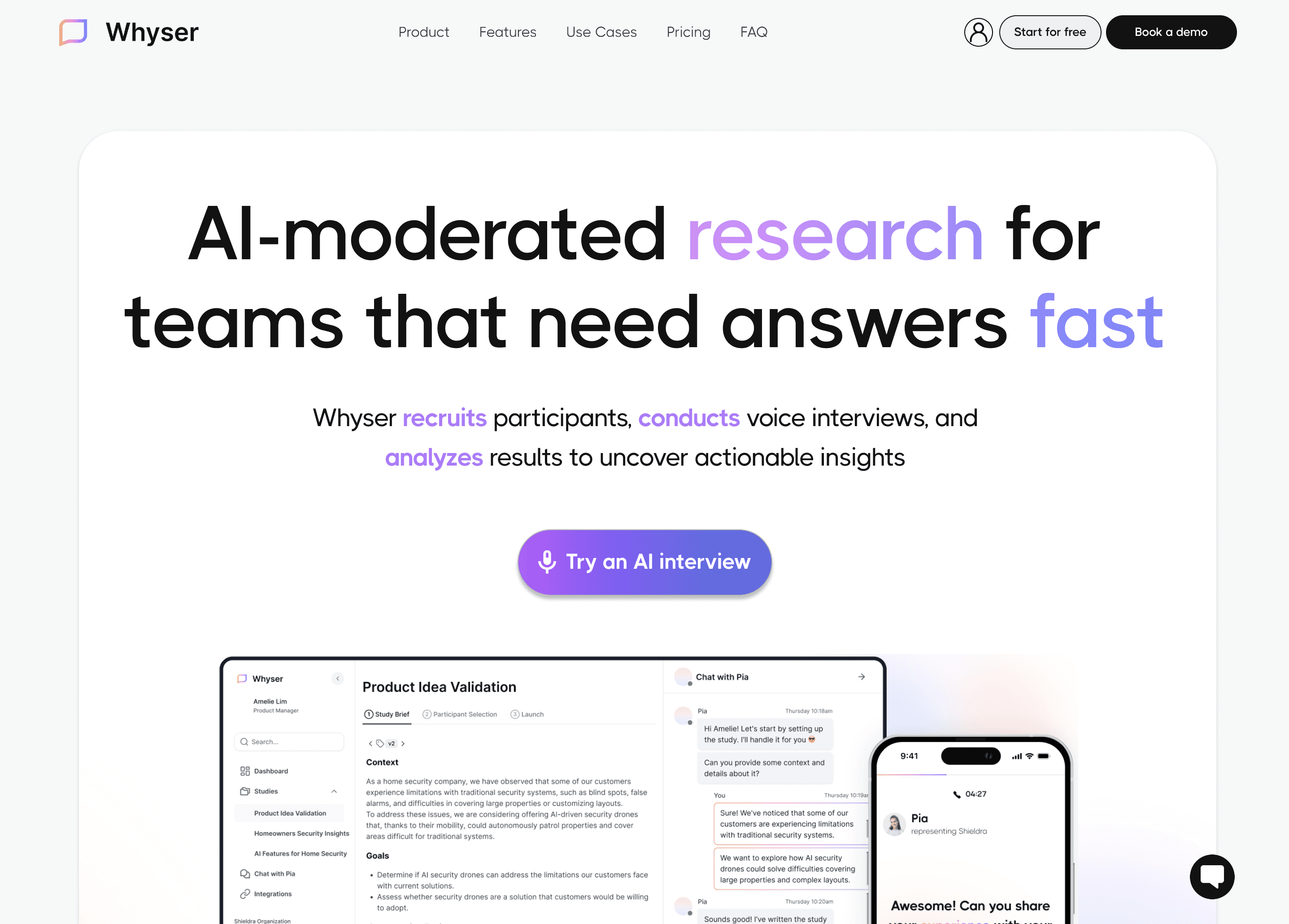
Redesigned Hero Section
Redesigned Hero Section
Simplified the hero messaging to make the value proposition clearer
Simplified the hero messaging to make the value proposition clearer
Reduced to a single primary CTA to avoid decision paralysis
Reduced to a single primary CTA to avoid decision paralysis
Included FAB at the bottom for easier access to ask questions
Included FAB at the bottom for easier access to ask questions
Product Demo
Product Demo
Video demonstration of the product briefly shows the platform
Video demonstration of the product briefly shows the platform
Video begins on mute and is only ~1 minute long
Video begins on mute and is only ~1 minute long


Interactive Prototype
Interactive Prototype
Added an interactive demo to show the AI interviewer in action
Added an interactive demo to show the AI interviewer in action
Research shows that users need proof of value before trust
Research shows that users need proof of value before trust
Enables users to actively explore features and build understanding
Enables users to actively explore features and build understanding


Key Features Grid
Key Features Grid
Features are shown late into the website
Features are shown late into the website
Video begins on mute and is only ~1 minute long
Video begins on mute and is only ~1 minute long

Key Features Carousel
Key Features Carousel
Refined to a continuous carousel to better balance passive and active browsing
Refined to a continuous carousel to better balance passive and active browsing
Has arrows to allow users to click through the carousel at their own speed
Has arrows to allow users to click through the carousel at their own speed

Use Cases
Use cases can be overwhelming to the user
Too much information increases cognitive load and drop-off

Reorganized Use Cases
Reorganized Use Cases
Changed the layout of the use cases
Changed the layout of the use cases
Previous information was removed due to being explained elsewhere
Previous information was removed due to being explained elsewhere

Current layout is not visually appealing
Current layout is not visually appealing
Information of each is too small making it hard to read
Information of each is too small making it hard to read

Revised the order of items in the feature using familiarity as an entry point to encourage user engagement
Revised the order of items in the feature using familiarity as an entry point to encourage user engagement

Usability testing revealed that users interpreted the original three examples as the full extent of Whyser’s capabilities
Usability testing revealed that users interpreted the original three examples as the full extent of Whyser’s capabilities
Previous information was removed due to being explained elsewhere
Previous information was removed due to being explained elsewhere
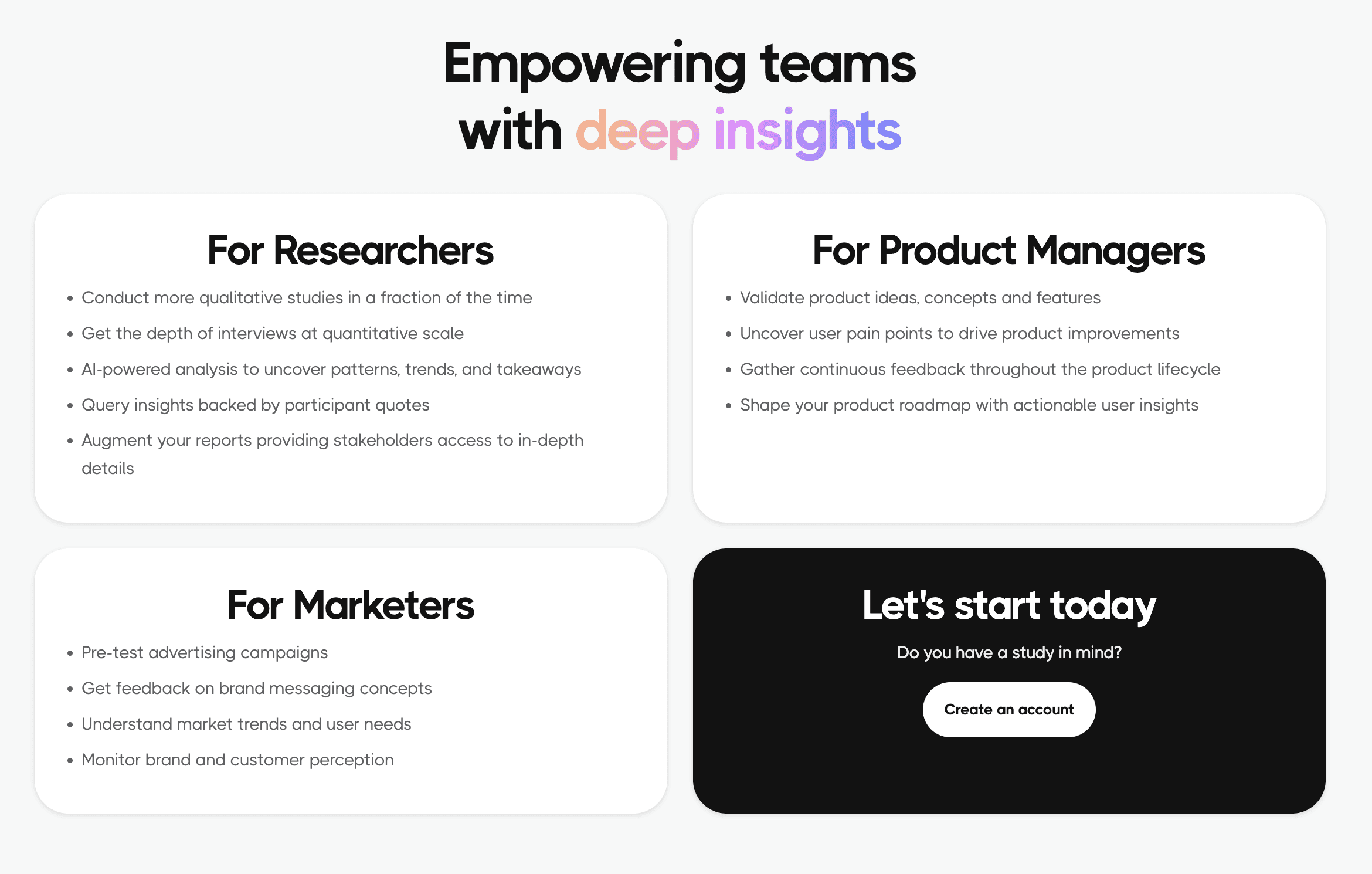
Section was reframed more broadly and paired with a “Learn More” call to action leading to a subpage
Section was reframed more broadly and paired with a “Learn More” call to action leading to a subpage
Help users understand that the platform supports a wider range of roles and scenarios
Help users understand that the platform supports a wider range of roles and scenarios

Testimonials
Testimonials
No title indicating these are the testimonials
No title indicating these are the testimonials
Does not match the websites aesthetics
Does not match the websites aesthetics

Testimonials Carousel
Testimonials Carousel
Auto-scroll carousel to show all the testimonials
Auto-scroll carousel to show all the testimonials
Refined to better balance passive and active browsing
Refined to better balance passive and active browsing

Pricing
Pricing
A lot of the points are different, making it hard for users to know what remains the same and what makes the other plans better
A lot of the points are different, making it hard for users to know what remains the same and what makes the other plans better

Pricing
Pricing
Simplified pricing comparison
Simplified pricing comparison
Introduced side-by-side pricing for better transparency
Introduced side-by-side pricing for better transparency

Overloaded FAQ
Overloaded FAQ
Too many FAQs that not everyone would want to read about
Too many FAQs that not everyone would want to read about
Text is small and hard to read
Text is small and hard to read
Contact information is hard to distinguish
Contact information is hard to distinguish

Reformatted FAQ
Reformatted FAQ
Reduced the number of FAQ based on which had the most clicks
Reduced the number of FAQ based on which had the most clicks
Bolded key words to grab users attention quicker
Bolded key words to grab users attention quicker
Added CTA for users who may have more questions
Added CTA for users who may have more questions
Highlighted contact information so users know where they can contact
Highlighted contact information so users know where they can contact

Lack of Contact Action
Lack of Contact Action
No action step between FAQ and Footer
No action step between FAQ and Footer
Lack of next steps for users who scrolled to the bottom of the page
Lack of next steps for users who scrolled to the bottom of the page
Users who reach the end still need a clear next step
Users who reach the end still need a clear next step
Embedded Booking Flow
Embedded Booking Flow
Added a bottom-of-page CTA section for users who scroll
Added a bottom-of-page CTA section for users who scroll
Replaced external Calendly link with an embedded booking form
Replaced external Calendly link with an embedded booking form


Footer
Footer
Lack of next steps for users who scrolled to the bottom of the page
Lack of next steps for users who scrolled to the bottom of the page
Not visually appealing, too much white space between footer information
Not visually appealing, too much white space between footer information

Improved Footer
Improved Footer
Improved visual consistency and polish
Improved visual consistency and polish

In execution, the final work aligned with our planned scope.
In execution, the final work aligned with our planned scope.
Our redesign solution:
Our redesign solution:
Introduced a more product-led experience with an interactive demo
Clearer value message delivering
Simplified pricing and service comparison
A more deliberate CTA hierarchy
Introduced a more product-led experience with an interactive demo
Clearer value message delivering
Simplified pricing and service comparison
A more deliberate CTA hierarchy
02 - ONBOARDING REDESIGN
02 - ONBOARDING REDESIGN
The onboarding redesign focused on creating a more guided first-study setup through step-by-step support and an example-based walkthrough, as well as changes of the onboarding structure to reduce cognitive overload.
The onboarding redesign focused on creating a more guided first-study setup through step-by-step support and an example-based walkthrough, as well as changes of the onboarding structure to reduce cognitive overload.
Users want greater confidence that they remain in control of the research process, which highlights the importance of user control and understanding of the platform.
Users want greater confidence that they remain in control of the research process, which highlights the importance of user control and understanding of the platform.
Before
Before
The platform provided a structured study setup, but users could feel uncertain about:
What to do next
What the AI would do
What to expect from the process
The platform provided a structured study setup, but users could feel uncertain about:
What to do next
What the AI would do
What to expect from the process
Usability Test - Guided Onboarding Experience
Usability Test - Guided Onboarding Experience
2 Participants
2 Participants
We recruited participants who did not have previous experience with Whyser to better evaluate the onboarding experience.
We recruited participants who did not have previous experience with Whyser to better evaluate the onboarding experience.
Focused on clarity and simplicity for easier completion with reduced cognitive load
Focused on clarity and simplicity for easier completion with reduced cognitive load
Refined Information Architecture
Refined Information Architecture
We refined the information architecture and split tasks into different clusters that consist of mandatory steps and optional tips.
We refined the information architecture and split tasks into different clusters that consist of mandatory steps and optional tips.
From our usability tests, some participants were uncertain about the function of the left-side onboarding tab and expected it to act as a more direct entry point, indicating that the navigation should be further refined to reduce users’ confusion.
From our usability tests, some participants were uncertain about the function of the left-side onboarding tab and expected it to act as a more direct entry point, indicating that the navigation should be further refined to reduce users’ confusion.
What We Changed
What We Changed
Added stronger visual cues for progress and completion states
Added stronger visual cues for progress and completion states
Refined the information architecture
Refined the information architecture
Why
Why
Reduce friction, uncertainty, and cognitive load
Reduce friction, uncertainty, and cognitive load
Surfacing value early
Surfacing value early

We streamlined the onboarding experience into four key guided steps, including mandatory introductory tutorials and optional tasks.
We streamlined the onboarding experience into four key guided steps, including mandatory introductory tutorials and optional tasks.
Based on participant feedback, participants found the layout version in which each of the four major stages contains both mandatory and optional tasks to be clearer and easier to follow because it showed not only the required path, but also the additional actions available within each stage.
Based on participant feedback, participants found the layout version in which each of the four major stages contains both mandatory and optional tasks to be clearer and easier to follow because it showed not only the required path, but also the additional actions available within each stage.
What We Changed
What We Changed
Added optional tasks and were designed around common user motivations and areas of interest
Added optional tasks and were designed around common user motivations and areas of interest
Why
Why
Allowing users to explore the features most relevant to why their needs
Allowing users to explore the features most relevant to why their needs

Side-by-Side Guide
Side-by-Side Guide
To make the study setup more guided, we added contextual support that remains accessible during setup as side pop-ups.
To make the study setup more guided, we added contextual support that remains accessible during setup as side pop-ups.
Participants appreciated having help content located near the relevant section. Simpler explanations were handled through tooltip information boxes, while more complex steps or sections will be shown with a side panel.
Participants appreciated having help content located near the relevant section. Simpler explanations were handled through tooltip information boxes, while more complex steps or sections will be shown with a side panel.
What We Changed
What We Changed
Improved the connection between onboarding and the actual setup experience
Improved the connection between onboarding and the actual setup experience
Why
Why
This creates a more continuous and supported experience instead of a disconnected one
This creates a more continuous and supported experience instead of a disconnected one

Introduced Two Onboarding Pathways
Introduced Two Onboarding Pathways
We set up two onboarding paths that allow users either to follow guided setup or explore a pre-loaded example.
We set up two onboarding paths that allow users either to follow guided setup or explore a pre-loaded example.
The third major refinement addressed the entry logic of onboarding. Participants showed some uncertainty about where onboarding should be resumed or accessed, and to resolve this, the onboarding button in the lower-left navigation was directly linked to the beginning of the onboarding flow.
The third major refinement addressed the entry logic of onboarding. Participants showed some uncertainty about where onboarding should be resumed or accessed, and to resolve this, the onboarding button in the lower-left navigation was directly linked to the beginning of the onboarding flow.
What We Changed
What We Changed
Introduced alternative paths for guided onboarding and product exploration for users to choose
Introduced alternative paths for guided onboarding and product exploration for users to choose
Why
Why
Allows users to experience real value early, instead of committing time before seeing what the product can actually do
Allows users to experience real value early, instead of committing time before seeing what the product can actually do
Enables users to familiarize themselves with Whyser in their preferred way
Enables users to familiarize themselves with Whyser in their preferred way

USABILITY TEST RESULTS
USABILITY TEST RESULTS
Our researched showed that trust needed to be established before users ever experienced Whyser’s core functionality. Participants wanted to see concrete proof of value, while first-time users needed more guidance and reassurance when learning the platform.
Our researched showed that trust needed to be established before users ever experienced Whyser’s core functionality. Participants wanted to see concrete proof of value, while first-time users needed more guidance and reassurance when learning the platform.
From Our Usability Testing:
From Our Usability Testing:

Users found the experience much clearer and easier to follow.
Users found the experience much clearer and easier to follow.
The step-by-step structure felt supportive rather than overwhelming, and combining videos with text improved understanding.
The step-by-step structure felt supportive rather than overwhelming, and combining videos with text improved understanding.

Progress indicators also played a big role; they increased users’ confidence and gave them a sense of control throughout the process.
Progress indicators also played a big role; they increased users’ confidence and gave them a sense of control throughout the process.
EXECUTION PLAYBACK
EXECUTION PLAYBACK
The final designs were shaped through an iterative, user-centred process that included early exploration, stakeholder feedback, high-fidelity prototyping, and usability testing.
The final designs were shaped through an iterative, user-centred process that included early exploration, stakeholder feedback, high-fidelity prototyping, and usability testing.
Interactive demo
Interactive demo
Highest Impact
Provide concrete understanding
Highest Impact
Provide concrete understanding
Reducing page length
Reducing page length
Lowered cognitive load
Improved user response
Lowered cognitive load
Improved user response
Visual consistency
Visual consistency
Clear action hierarchy
Polished UI acted as trust signals
Clear action hierarchy
Polished UI acted as trust signals

CONCLUSION
CONCLUSION
Across both deliverables, our work addressed a common early-stage problem in the current product experience.
Across both deliverables, our work addressed a common early-stage problem in the current product experience.
Overall, this project demonstrates that trust in AI-supported research tools is shaped not only by product capability itself, but also by how clearly that capability is introduced, structured, and supported during the first-time experience.
Overall, this project demonstrates that trust in AI-supported research tools is shaped not only by product capability itself, but also by how clearly that capability is introduced, structured, and supported during the first-time experience.
Thank you!
Thank you!
Try our prototype here >>>
Try our prototype here!
Desktop view only
Desktop view only
